
- Website
- Bookmark
- Share
- Leave a review
- Claim listing
- Report
- prev
- next
Description
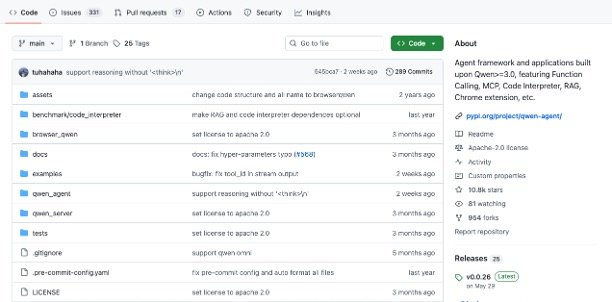
Qwen-Agent is an open-source framework designed for developing AI applications using Qwen large language models (LLMs). It enables Qwen models to act as intelligent agents capable of following instructions, calling external functions/tools, planning multi-step tasks, and maintaining memory for context-aware interactions. The framework focuses on integrating tool usage, memory management, and autonomous reasoning to build powerful AI agents that can perform complex workflows efficiently.
Key Features:
- Function Calling & Tool Integration: Supports easy definition and use of tools such as web browsing, code execution, and database queries, allowing agents to extend their capabilities dynamically.
- Planning & Memory Management: Enables multi-step internal task planning and long-term memory to maintain context across interactions for better task execution.
- Built-in Code Interpreter: Integrates Python code execution directly within the agent for tasks like data analysis and visualization (note: code runs in the host environment, not sandboxed).
- Multi-Provider & Modular Design: Compatible with various deployment modes, including cloud or local model servers, and supports modular assembly of agents with flexible configuration.
Use Cases:
- Automating complex workflows requiring multi-step reasoning, data fetching, and code-driven analysis.
- Building intelligent virtual assistants that can interact with web pages, documents, and APIs to gather and summarize information.
- Developing AI-powered tools for data visualization, research assistance, or task automation integrating custom and external tools.
Technical Specifications:
- Written primarily in Python; compatible with Python 3.10+.
- Supports multiple Qwen models including Qwen3 with API-compatible endpoints like DashScope or OpenAI-compatible servers (e.g., vLLM, Ollama).
- Provides optional components including GUI support via Gradio, retrieval-augmented generation (RAG), and multi-component protocol (MCP) for tool orchestration.
Gallery
AI Agents Category
Reviews
Add a review
You May Also Be Interested In
Pinkfish AI
Build enterprise automations by simply describing what you want.
$
Paid, Free Trial