
EditGPT Review 2026: Is It Good for Academic Writing?

EditGPT Review 2026: Is It Good for Academic Writing?
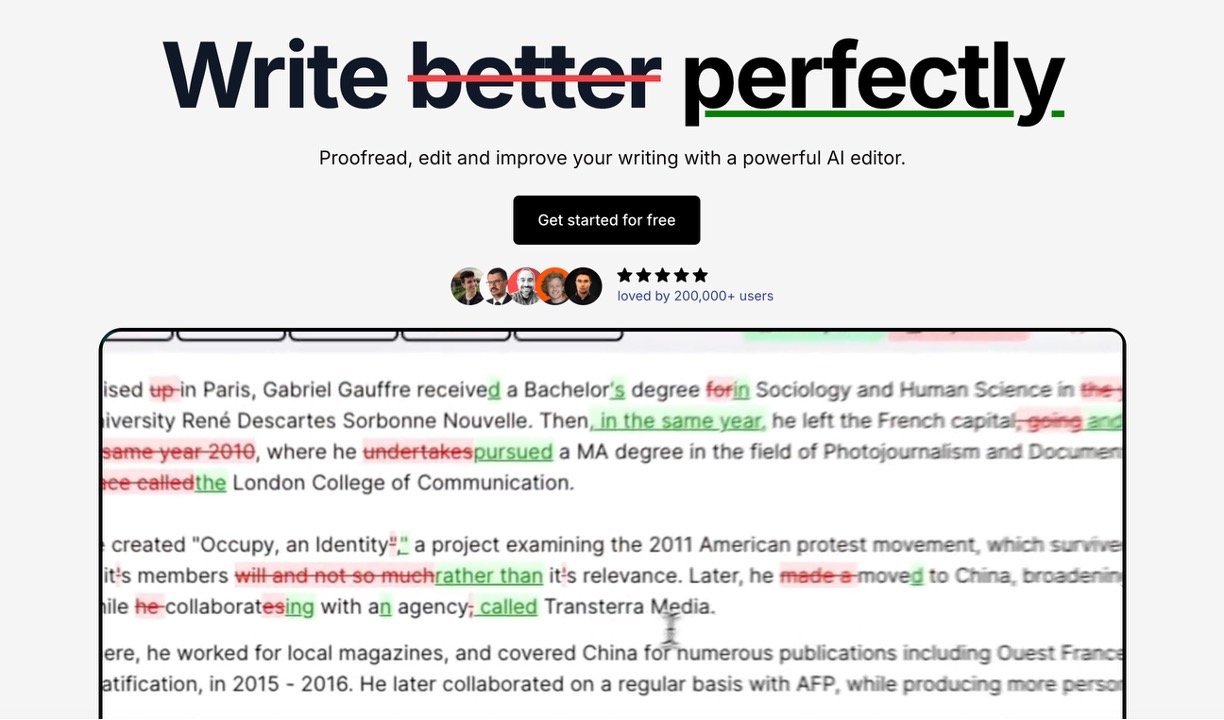
EditGPT is an AI proofreading and editing tool built for writers who want to see every change instead of receiving a completely rewritten paragraph. It works through a web editor and a Chrome extension for ChatGPT. For academic writers, its strongest use is the final revision stage: fixing grammar, improving clarity, making wording more formal, and checking consistency.
The tool is easy to learn because its red and green markup feels like Track Changes in Microsoft Word. However, EditGPT is an editor, not a complete academic research platform. It does not search scholarly databases, verify evidence, generate reliable citations, or manage references. I would use it to polish a finished paper—not to research or fact-check one.
Key Features and Ratings
| Feature | Our Rating |
| AI proofreading and grammar | 4.4/5 |
| Accept/reject tracked changes | 4.7/5 |
| Academic tone and clarity | 4.1/5 |
| Custom editing prompts | 4.5/5 |
| Word import and export | 4.3/5 |
| Long-document support | 4.4/5 |
| Ease of use | 4.3/5 |
| Extension reliability | 3.6/5 |
| Overall rating | 4.3/5 |
Key Features
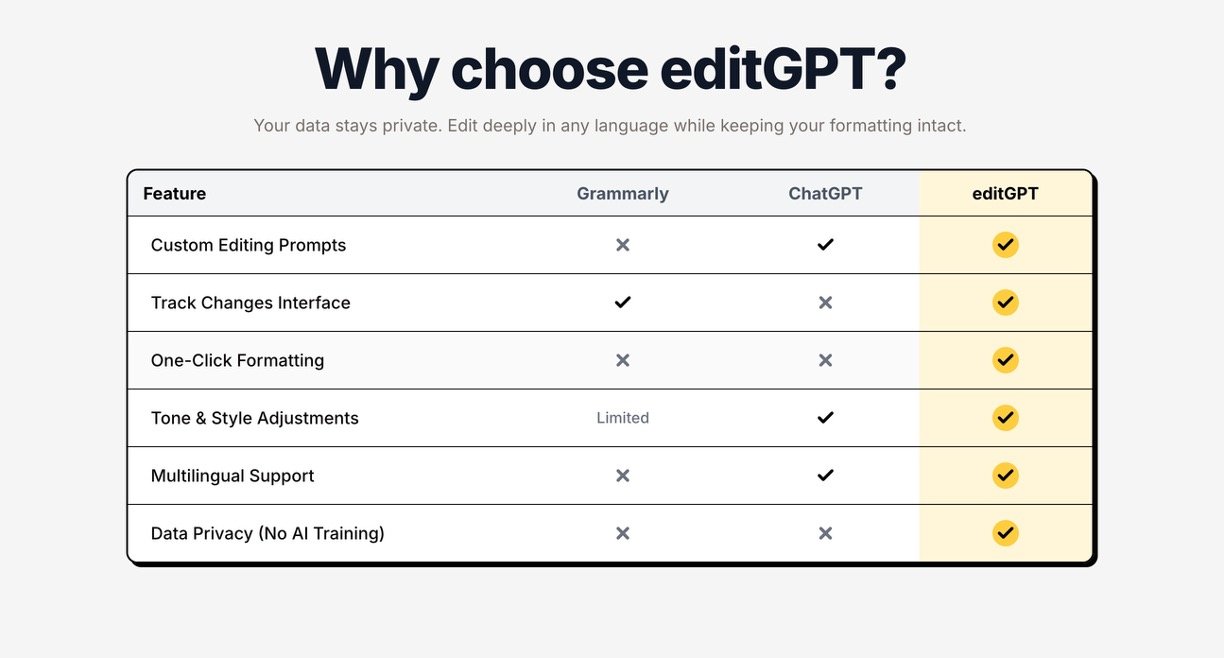
Track Changes is the main reason to choose EditGPT. The tool highlights additions and deletions, then lets you accept or reject them. This gives researchers much more control than a normal chatbot rewrite and makes it easier to protect technical meaning.
The editing options cover light grammar correction, proofreading, clarity improvement, natural rewriting, and deeper rewriting. Custom prompts are especially useful for instructions such as “use concise academic English,” “keep all citations unchanged,” or “do not alter technical terms.” Paid plans also let users save prompts, which helps maintain the same style across chapters.
EditGPT supports Word import and export, revision history, a suggestions panel, rich text, and documents of up to 200,000 words on paid plans. It can work in many languages, although quality may be less consistent outside widely supported languages.
Public feedback follows a clear pattern. Users like the clean interface, fast results, context-aware suggestions, and freedom to approve each edit. Some say it understands context better than rule-based grammar checkers. The main complaints involve the browser extension occasionally breaking when ChatGPT changes its interface, buttons disappearing, incomplete markup, and formatting problems with lists or line breaks. For serious work, the standalone web editor is the safer choice.
Pricing
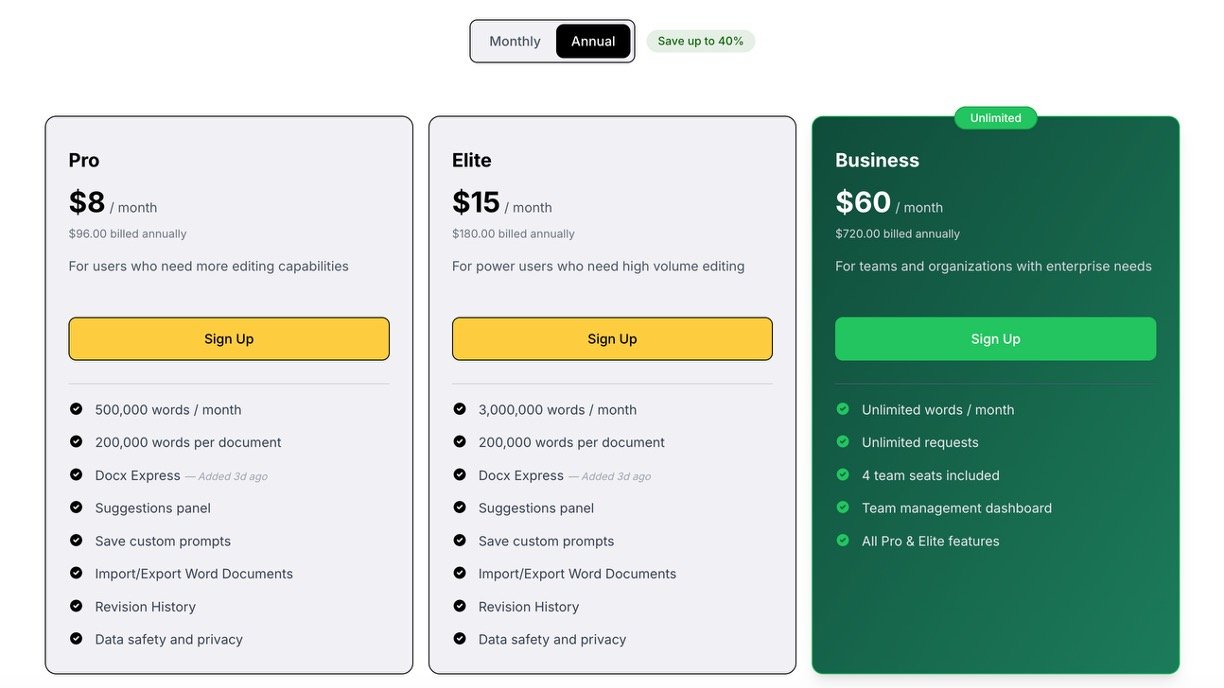
The Free plan includes 10,000 words per month and is suitable for short papers or testing. Pro provides 500,000 words per month, up to 200,000 words per document, Word import and export, saved custom prompts, revision history, Docx Express, and the suggestions panel. Elite raises the monthly allowance to 3,000,000 words while keeping the 200,000-word document limit.
Published monthly prices are about $12 for Pro and $25 for Elite; annual billing can reduce the effective monthly cost. Since EditGPT sometimes changes discounts and plan details, check the checkout page before subscribing.
Pros and Cons
Pros: Excellent tracked changes, strong contextual editing, simple interface, flexible prompts, useful Word workflow, and generous paid limits.
Cons: No literature search or citation verification, output still needs expert review, the extension can be unstable, and repeated passes consume the word allowance.
Verdict
EditGPT is a strong last-stage academic editor. It is best for students, researchers, and ESL writers who already have a draft and want transparent, controllable revisions. It cannot replace subject expertise, a reference manager, or a human academic editor, but it can make careful proofreading much faster.

