
AI Agents Courses for Software Engineers and Product Managers: Building Autonomous Workflows
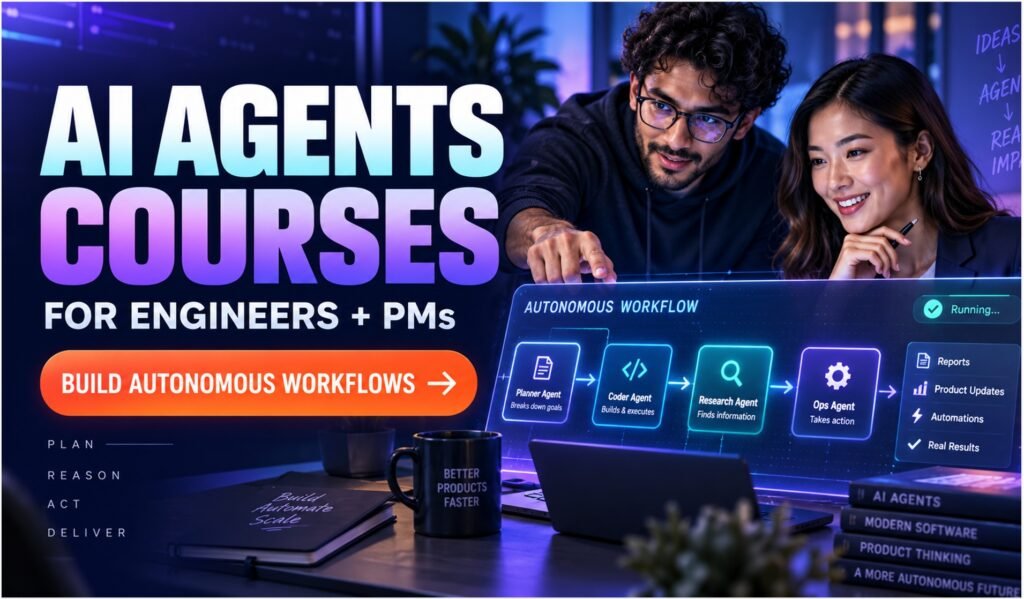
AI Agents Courses for Software Engineers and Product Managers: Building Autonomous Workflows
AI agents are changing how software teams approach automation. Instead of building workflows around fixed rules, engineers can now create systems that retrieve information, select tools, reason through multiple steps, and decide the next action.
For software engineers, this creates new technical requirements around RAG, memory, APIs, orchestration, evaluation, and deployment. Product managers face a related challenge: understanding where autonomous workflows add value, how much control an agent should receive, and what safeguards are needed before it reaches users.
The five programs below approach those needs from different angles, ranging from hands-on agent development to product strategy and enterprise deployment.
Overview: 5 AI Agents Courses
| # | Program & Provider | Duration | Fee | Best Aligned With |
| 1 | Post Graduate Program in AI Agents and Generative AI for Business Applications – The McCombs School of Business at The University of Texas at Austin | 13 weeks | US$3,450 | RAG, AI agents, multi-agent workflows |
| 2 | Agentic AI Architecture Certificate – Cornell University | 2 months | US$3,750 | RAG, memory, tool use, agent architecture |
| 3 | Certificate Program in Agentic AI – Johns Hopkins University | 18 weeks | US$3,450 | Agentic RAG, MCP, multi-agent systems, AgentOps |
| 4 | Certificate in Agentic AI Solutions for Managers – Georgetown University | 6 weeks | US$2,995 | Product strategy, workflow design, AI governance |
| 5 | Leading Enterprise Agentic AI Development – Carnegie Mellon University | About 4 weeks | US$4,250 | Enterprise agents, multi-agent architecture, governance |
1. Post Graduate Program in AI Agents and Generative AI for Business Applications – The McCombs School of Business at The University of Texas at Austin
This AI Agents Course Online moves from Generative AI and LLM evaluation into RAG, single-agent architectures, planning, reasoning, and multi-agent systems. Learners can follow a Python-based code track or a no-code track, making the program relevant to both technical builders and professionals managing AI-enabled workflows.
Delivery & Duration: Online, 13 weeks, combining recorded faculty content, live industry mentorship, and faculty-led sessions.
Credentials: Certificate of Completion and CEUs from The McCombs School of Business at The University of Texas at Austin.
Program Highlights: RAG, embeddings, vector databases, LLM-as-a-Judge, gold-standard datasets, agent memory, ReAct, MCP, secure tool access, LangChain, LangGraph, LangSmith, ChromaDB, human feedback loops, and multi-agent systems.
Outcomes: Learners develop context-aware agents, evaluate retrieval and model outputs, apply planning strategies, and design multi-agent workflows for business automation.
Why should you choose this course?
- It accommodates different roles. Software professionals can work through Python, while product and functional professionals can use the no-code path.
- The curriculum connects GenAI with autonomous workflows. RAG and evaluation come before single-agent and multi-agent design.
2. Agentic AI Architecture Certificate – Cornell University
Cornell’s certificate focuses on designing reliable LLM applications rather than learning one agent framework. Learners progress from LLM APIs and context management into RAG, structured data access, memory, tools, orchestration, and agentic architecture.
Delivery & Duration: Online, two months across four courses, with roughly 8 to 10 hours of study per week.
Credentials: Agentic AI Architecture Certificate from Cornell University.
Program Highlights: Embeddings, vector search, RAG, NL-to-SQL, tool calling, memory, routing, parallelization, orchestrator-worker patterns, reflection loops, MCP, evaluation, governance, and security.
Outcomes: Learners build grounded retrieval systems and tool-using agents while developing the architectural judgment needed to balance reliability, cost, latency, and oversight.
Why should you choose this course?
- The projects progress from simple LLM calls to complete agentic workflows.
- Technical product managers are part of the intended audience, alongside developers, ML engineers, and technical leaders.
3. Certificate Program in Agentic AI – Johns Hopkins University
The Johns Hopkins AI Agents Course starts with Python and LLM foundations, then progresses through RAG, Agentic RAG, ReAct, MCP, multi-agent systems, reinforcement learning, observability, and production deployment.
Delivery & Duration: Fully online, 18 weeks, with faculty instruction, 16+ live mentor sessions, three hands-on projects, and real-world case studies.
Fee: US$3,450.
Credentials: Certificate of Completion and 13 CEUs from Johns Hopkins University.
Program Highlights: LangGraph, LangChain, DSPy, CrewAI, AutoGen, ChromaDB, MCP, GraphRAG, RAGAS, DeepEval, LangSmith, LangFuse, A2A communication, PPO, guardrails, monitoring, and AgentOps.
Outcomes: Learners build autonomous agents, evaluate hallucinations and system accuracy, coordinate multi-agent workflows, and prepare systems for monitored production use.
Why should you choose this course?
- The technical sequence continues into operations. Security, logging, observability, evaluation, and deployment follow agent development.
- Projects become progressively more complex, ending with a multi-agent mortgage underwriting system.
4. Certificate in Agentic AI Solutions for Managers – Georgetown University
Georgetown approaches autonomous workflows from a management and product perspective. Participants learn how agents use LLMs, vector databases, decision frameworks, and limited autonomy while also examining governance and enterprise value.
Delivery & Duration: Online, six weeks, totaling 32 contact hours.
Fee: US$2,995.
Credentials: Georgetown University certificate and 3.2 CEUs.
Program Highlights: Agent solution design, vector databases, workflow optimization, vendor-independent architecture, governance, ethics, strategic use-case selection, and responsible deployment.
Outcomes: Participants learn to define agentic use cases, assess business value, and guide the design and deployment of autonomous systems with appropriate oversight.
Why should you choose this course?
- It aligns directly with managers and innovation leads, not just developers.
- Technical fluency is tied to product decisions, governance, and measurable business outcomes.
5. Leading Enterprise Agentic AI Development – Carnegie Mellon University
Carnegie Mellon’s program focuses on taking autonomous workflows into enterprise environments. It combines agent architecture with the data, security, governance, and operating structures required to deploy agents responsibly.
Delivery & Duration: Five live virtual modules plus an applied lab, delivered across approximately four weeks.
Fee: US$4,250.
Credentials: LEAAID Certificate from Carnegie Mellon University’s Heinz College.
Program Highlights: Multi-agent architectures, planning, orchestration, vector databases, APIs, real-time data pipelines, model validation, red teaming, monitoring, secure deployment, human oversight, and an applied agent-design lab.
Outcomes: Participants learn to design agent-enabled workflows, evaluate enterprise architecture requirements, establish governance controls, and prototype an agent-based solution.
Why should you choose this course?
- It links agent design with enterprise infrastructure and assurance.
- The applied lab connects strategy with implementation, including tool integration, orchestration, and output evaluation.
Conclusion
Software engineers and product managers approach autonomous workflows from different starting points, but both need to understand how retrieval, tools, memory, orchestration, evaluation, and human oversight fit together.
Choosing Agentic AI Courses therefore depends on the role you expect to play. Developers may need deeper implementation and production skills, while product managers may place greater weight on workflow design, governance, risk, and deciding where agent autonomy creates genuine value.
