
- Website
- Bookmark
- Share
- Leave a review
- Claim listing
- Report
- prev
- next
Description
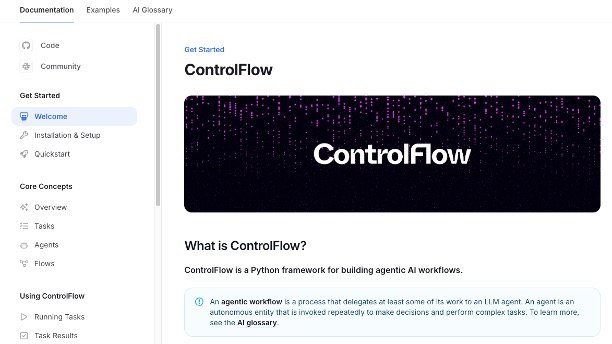
ControlFlow is an open-source Python framework developed by Prefect that enables building, managing, and orchestrating intelligent AI workflows powered by large language models (LLMs). It breaks down complex AI tasks into discrete, observable steps called tasks, which can be assigned to specialized AI agents. These tasks combine into cohesive flows that can dynamically adapt based on intermediate results, allowing flexible, agentic workflows where AI agents self-direct by creating their own plans and toolsets. ControlFlow is built on top of Prefect 3.0, leveraging proven workflow orchestration technology to provide strong observability, control, and composability for AI-driven processes.
Key Features:
- Task-Centric Design: Defines AI workflows as discrete tasks with clear objectives and measurable outcomes, improving resilience and reproducibility.
- Granular Agent Assignment: Assign specialized agents with different instructions, models, and tools to individual tasks for optimized performance.
- Dynamic, Flexible Workflows: Supports adaptive paths, spawning new tasks on the fly based on intermediate results for complex problem-solving.
- Advanced Observability & Control: Provides detailed tracing, debugging, and live intervention capabilities to monitor AI decision-making and maintain trust.
Use Cases:
- Automating multi-step research or data analysis workflows that require reasoning, summarization, and data extraction.
- Building multi-agent systems where different AI agents collaborate on complex business processes or software automation.
- Implementing transparent, human-in-the-loop AI workflows with monitoring, fallback, and error handling for enterprise applications.
Technical Specifications:
- Core Framework: Python-based, built on Prefect 3.0 workflow engine for scalable and reliable orchestration.
- LLM Integration: Compatible with multiple large language models including OpenAI GPT-4 and Anthropic Claude.
- Extensibility & Monitoring: Supports custom task definitions, structured result types, multi-agent task execution, robust error handling, and full observability for debugging and optimization.
Gallery
AI Agents Category
Reviews
Add a review
You May Also Be Interested In
Pinkfish AI
Build enterprise automations by simply describing what you want.
$
Paid, Free Trial