
- Website
- Bookmark
- Share
- Leave a review
- Claim listing
- Report
- prev
- next
Description
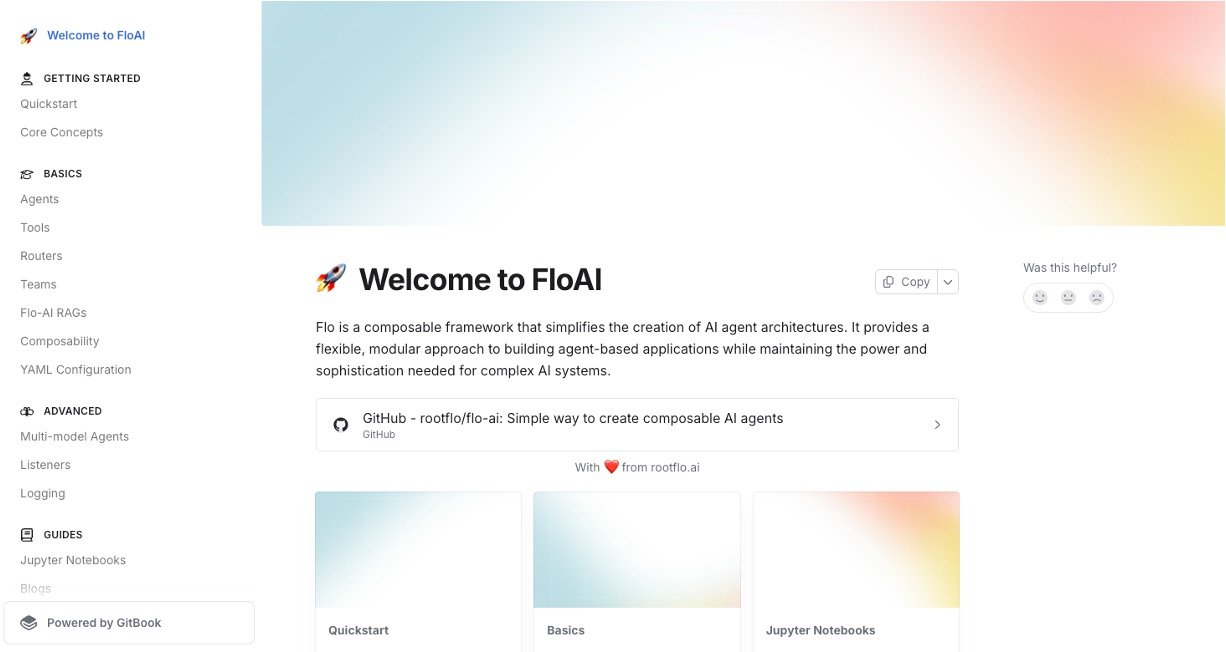
FloAI is a flexible, composable framework that simplifies the creation of AI agent architectures for a new generation of intelligent applications. With FloAI, developers can design, deploy, and orchestrate AI agents that act autonomously, manage complex workflows, and interact with external systems. Its modular approach allows for easy integration and scaling, supporting sophisticated applications such as task automation, interactive chatbots, and advanced workflow orchestration—all with rapid prototyping and maintainability in mind.
Key Features:
- Composable agent architecture: Build applications using flexible, interchangeable agent components for linear or hierarchical workflows.
- Wide variety of agent types: Supports LLM agents, tool agents, delegator agents, reflection agents, and more, each tailored for specific roles and decision-making.
- Advanced routing and orchestration: Includes supervisor, linear, and LLM-based routers for dynamically assigning and managing tasks amongst agents.
- Strong developer support: Quickstarts, Jupyter notebook examples, and YAML-based configurations enable rapid learning, testing, and deployment.
Use Cases:
- Automating end-to-end business processes, such as data analysis, document processing, and email summarization, with minimal manual intervention.
- Building intelligent chatbots that dynamically decide when to use external tools or fetch real-time data during conversations.
- Orchestrating multi-step workflows in research, enterprise solutions, or complex software projects, leveraging modular agent collaboration.
Technical Specifications:
- Python-based framework with core support for asynchronous tasks, advanced error handling, and extensible logging.
- Composable with other AI frameworks and supports defining complex agent interactions and workflows via YAML configuration files.
- Free and open-source, with strong community involvement and seamless integration with leading LLMs and on-premise deployments.
Gallery