

- Website
- Bookmark
- Share
- Leave a review
- Claim listing
- Report
- prev
- next
Description
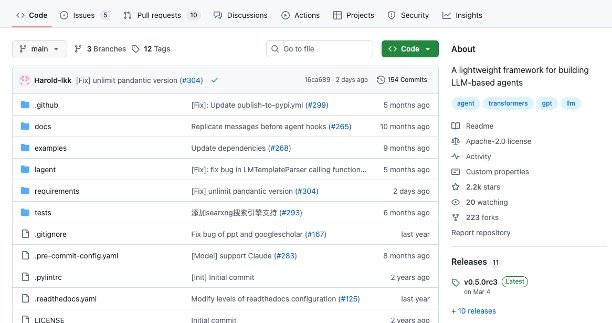
Lagent is a lightweight, open-source Python framework designed to help users efficiently build AI agents powered by large language models (LLMs). It follows a design philosophy inspired by PyTorch, making the development process intuitive and Pythonic by focusing on defining agents, tools, and memory as modular components. Lagent supports multiple types of agents such as ReAct, AutoGPT, and ReWOO, enabling complex reasoning, function calling, and multi-agent workflows. It also integrates key tools like Python interpreters, API calls, and Google Search to augment agent capabilities.
Key Features:
- Multiple Agent Types Supported: Includes ReAct, AutoGPT, and ReWOO agents that enable advanced reasoning and function execution.
- Simple and Extendable: Clear, concise structure allowing users to create functional agents with about 20 lines of code.
- Supports Various LLMs: Compatible with both API-based models (e.g., GPT-3.5/4) and open-source models like LLaMA 2 and InternLM.
- Integrated Tool Ecosystem: Provides built-in tools including Python interpreter, Google Search, and API calling for enhanced agent functionality.
Use Cases:
- Developing AI chatbots that answer complex questions utilizing external tools and databases.
- Automating problem-solving workflows like coding assistance or research with multi-step reasoning.
- Creating multi-agent systems where agents collaborate to handle complex tasks or refine outputs.
Technical Specifications:
- Programming Environment: Python-based, inspired by PyTorch for easy agent and module design.
- Memory & Communication: Agents use AgentMessage for communication and maintain memory of interactions for context.
- Extensibility & Deployment: Supports synchronous and asynchronous agent interfaces, plugin action executors, and can be run locally or deployed with standard Python environments.
Gallery

