

- Website
- Bookmark
- Share
- Leave a review
- Claim listing
- Report
- prev
- next
Description
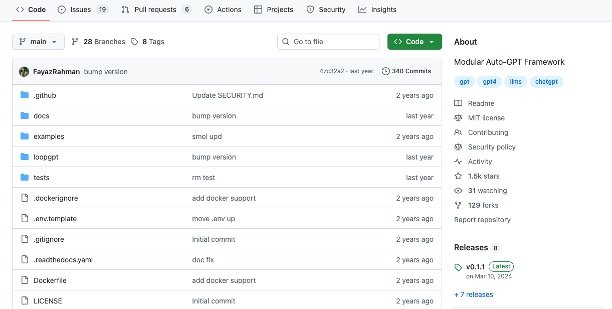
LoopGPT is a modular and extensible Python framework that re-implements the popular Auto-GPT project with enhanced flexibility and efficiency. It is designed for developers and AI enthusiasts to create autonomous AI agents that can run complex workflows with ease, offering a powerful "Plug N Play" API that allows integration of custom features directly from Python code without requiring complex configuration files. The framework is optimized for GPT-3.5, providing better performance for users without access to GPT-4, and focuses on low token usage for cost-effective AI interactions. LoopGPT also supports human-in-the-loop feedback to correct agent actions dynamically and includes full state serialization to save and reload the complete agent state (memory, tool states) seamlessly without needing external databases.
Key Features:
- Extensible "Plug N Play" Pythonic API for easy addition of new capabilities and custom tools.
- Optimized for GPT-3.5, delivering improved results and efficiency over typical Auto-GPT versions.
- Minimal prompt overhead for efficient token utilization, reducing API cost.
- Human-in-the-loop feedback mechanism allowing users to guide and correct agent behavior interactively.
Use Cases:
- Automating research tasks such as product comparisons, data gathering, and analysis.
- Building custom AI assistant agents that perform multi-step tasks autonomously.
- Developing agents for generating reports, file operations, and scheduling based on user instructions.
Technical Specifications:
- Python package compatible with Python 3.8+ and installable via PyPI or from source.
- Supports integration with OpenAI APIs, utilizing GPT-3.5 by default but also compatible with GPT-4.
- State management system that saves agent memory, tools, and session state to JSON files or Python objects for persistence.
Gallery

