
Anara AI Review: A Smarter Way to Research Papers

Anara AI Review: A Strong Workspace for Source-Based Research
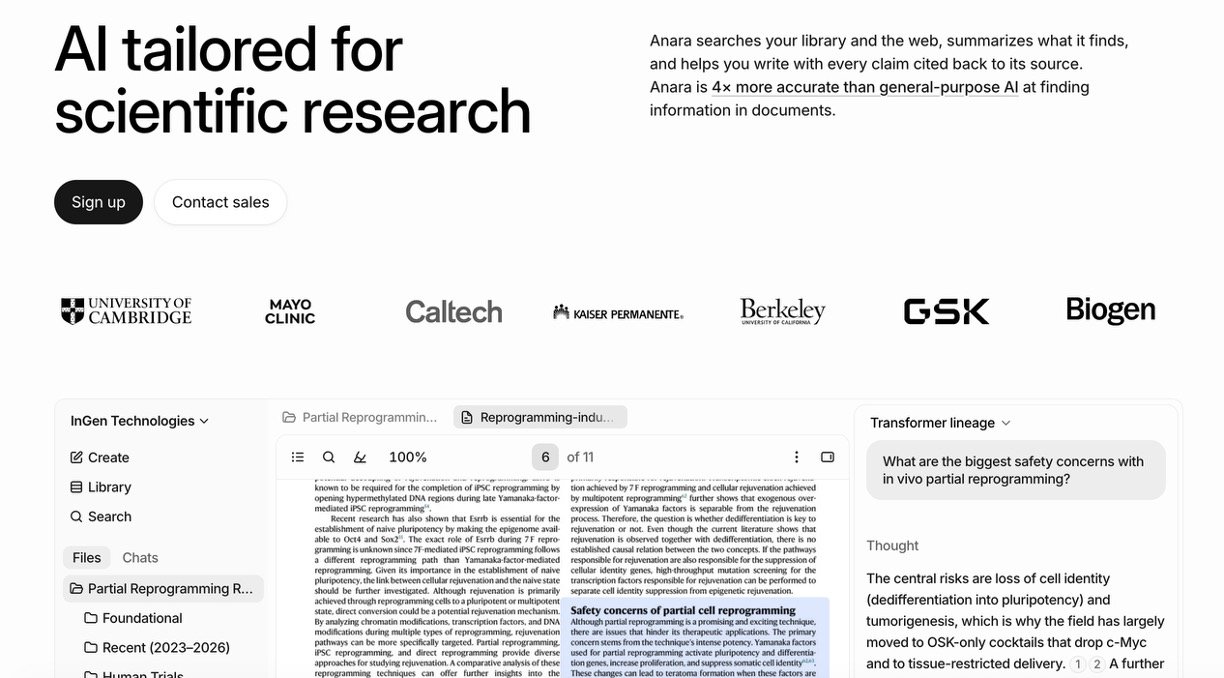
Anara is an AI research workspace for students, academics, scientists, and research teams. It brings document reading, AI chat, note-taking, citation management, and writing into one clean interface. You can upload papers, connect research libraries, search the web and academic databases, and ask questions across one document or a large collection.
Its best feature is traceability. Answers include clickable citations that open the exact supporting passage, making fact-checking much faster than with a general chatbot. It is especially useful for literature reviews, comparing studies, understanding difficult papers, and drafting source-based notes. However, it should assist critical reading—not replace it.
Anara AI Key Features and Ratings
| Anara AI Feature | Our Rating |
| Source-linked answers | 4.8/5 |
| Multi-document analysis | 4.6/5 |
| Research library and PDF tools | 4.5/5 |
| Citation and export options | 4.4/5 |
| Integrations | 4.5/5 |
| Writing assistance | 3.8/5 |
| Value for money | 4.0/5 |
| Overall rating | 4.4/5 |
Anara AI Key Features
Research chat: Anara searches uploaded documents, your connected sources, academic databases, and the open web. You can ask it to summarize a paper, compare methods, extract findings, or explain technical language.
Verifiable citations: Every answer links to supporting text. This does not guarantee that the interpretation is correct, but it makes checking the answer quick and practical.
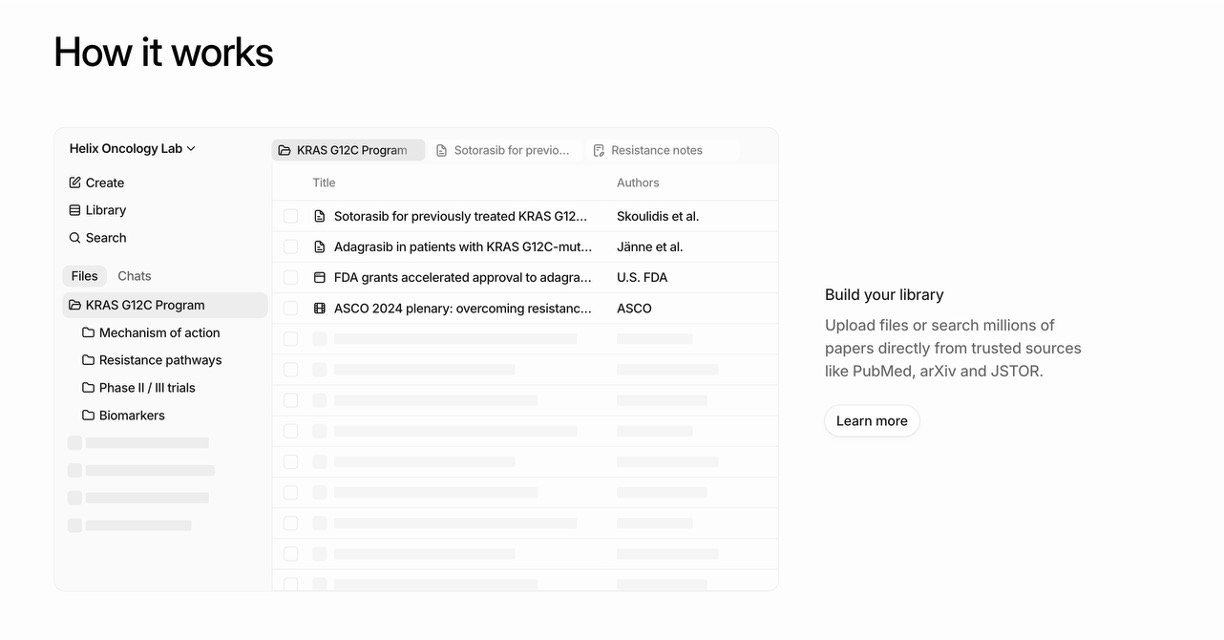
Large research library: Files can be organized with folders, tags, notes, highlights, and comments. Anara supports PDFs, Word files, slides, EPUB, images, audio, video, web pages, and YouTube links.
Writing and export tools: The note editor can create cited drafts and formatted references. Work can be exported as Word, PDF, LaTeX, HTML, BibTeX, or CSV. It can also create charts, spreadsheets, images, and run code for analysis.
Useful integrations: Zotero and Mendeley are available on the free plan. Higher plans add scientific databases and services such as PubMed, ClinicalTrials.gov, Google Drive, Notion, OneDrive, Dropbox, Slack, and Teams.
Anara AI Pros and Cons
The main strengths are accurate source linking, fast comparison of many papers, broad file support, and a smooth all-in-one workflow. Researchers who already have a large Zotero or Mendeley library will gain the most value.
The weaknesses are equally important. AI summaries can flatten theoretical arguments or miss methodological nuance, so important claims still need manual review. Writing support is less complete than a dedicated academic editor, with no built-in plagiarism checker. Some users also find the free limits restrictive and have reported confusion about usage or annual billing. Check the billing cycle carefully before subscribing.
Anara AI Pricing
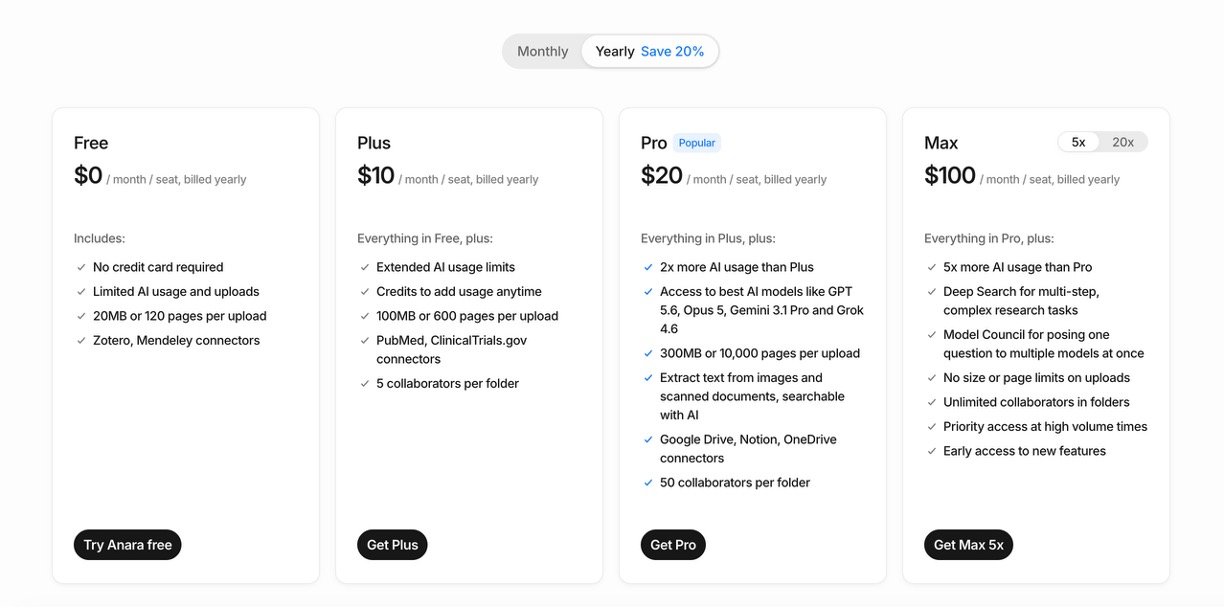
Anara has a free plan with limited daily AI use, uploads up to 20 MB or 120 pages, and Zotero/Mendeley connections. With annual billing, Plus costs $10 per month per seat and raises the upload limit to 100 MB or 600 pages. Pro costs $20 and adds more usage, all available AI models, OCR, cloud integrations, and uploads up to 300 MB or 10,000 pages. Max 5x costs $100 and adds Deep Search, Model Council, unlimited upload size, and more usage. Enterprise pricing is custom. Monthly billing is also available but costs more.
Our Verdict
Anara is a very good choice for document-heavy academic work where every statement must be checked against a source. It saves time without hiding the evidence. It is less suitable for users who mainly need proofreading, plagiarism checks, or fully automated academic writing.

