
- Website
- Bookmark
- Share
- Leave a review
- Claim listing
- Report
- prev
- next
Description
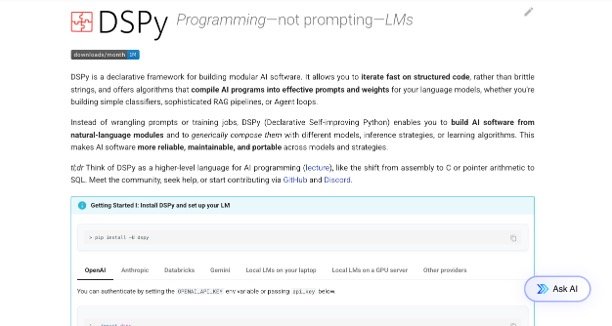
DSPy is a declarative framework designed for building modular AI software by programming language models (LMs) rather than using traditional prompt engineering. It lets developers create structured AI workflows using natural-language modules as code components. This modular design makes AI systems more reliable, maintainable, and portable across different LMs and inference strategies. DSPy also includes built-in optimization tools that automatically fine-tune prompts and model weights, enabling faster development and improved AI performance.
Key Features:
- Modular AI Programming: Build AI behaviors with structured natural-language modules instead of brittle prompt strings.
- Built-in Optimizers: Automatically improve AI system quality by optimizing prompts and model weights based on task-specific metrics.
- Support for Multiple LLMs and APIs: Compatible with various language models and services, enabling flexible deployment.
- Composable Workflows: Enables chaining and combining modules into complex pipelines and multi-step AI applications.
Use Cases:
- Developing AI agents with clear structured workflows for tasks like question answering or data extraction.
- Optimizing retrieval-augmented generation (RAG) pipelines to improve search and information accuracy.
- Building complex AI-powered applications that require reliable, maintainable code over ad-hoc prompting.
Technical Specifications:
- Programming primarily in Python with strong support for type signatures describing module inputs and outputs.
- Includes a compiler component that fine-tunes modules by generating better prompts and adjusting model weights.
- Integrates with popular AI model providers, supporting both cloud and local deployments.
Gallery