
- Website
- Bookmark
- Share
- Leave a review
- Claim listing
- Report
- prev
- next
Description
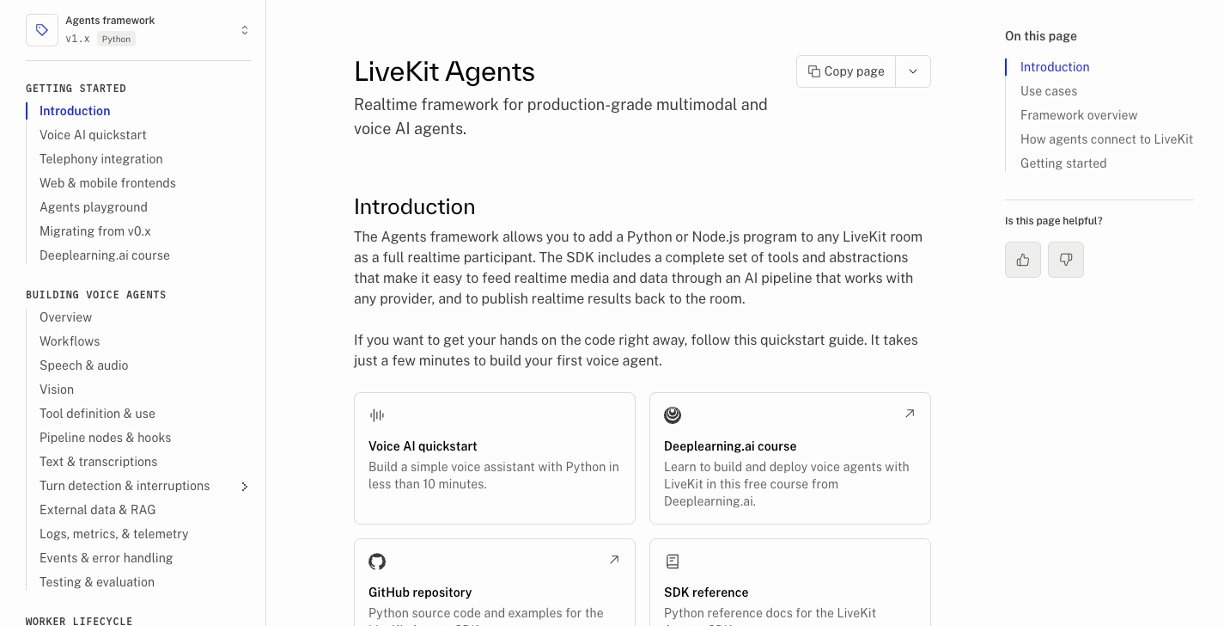
LiveKit Agents is an open-source framework for building programmable AI participants that connect to LiveKit rooms in real-time using voice, video, and text. Designed for developers to create flexible, multimodal AI agents, it supports large language models (LLMs) and integrates easily with speech-to-text, text-to-speech, and voice activity detection tools. The framework handles the complexities of real-time communication with reliable WebRTC connections and robust orchestration for scaling and production deployment. Use cases range from AI voice assistants and call centers to telehealth, real-time translation, AI-driven avatars, and robotics, highlighting its versatility for interactive, live AI applications.
Key Features:
- Multimodal input and output: processes audio, video, and text concurrently for rich interaction.
- Extensive plugin ecosystem: integrates seamlessly with major AI providers (OpenAI, Deepgram, Google, ElevenLabs, etc.) and supports custom plugins.
- Real-time communication and orchestration: built-in worker orchestration, load balancing, WebRTC media transport ensuring low latency and high reliability.
- Developer-friendly: open-source SDKs in Python and Node.js, with tools like an agents playground for quick prototyping and smooth deployment to LiveKit Cloud or self-hosted environments.
Use Cases:
- AI voice assistants and virtual agents for customer service, telephony, and call centers.
- Real-time translation and transcription services enhancing communication across languages.
- Interactive, lifelike NPCs in gaming or AI-driven avatars for immersive user experiences.
Technical Specifications:
- SDK supports Python and Node.js for building backend agents, with client frontends connecting via LiveKit rooms.
- Utilizes WebRTC for efficient, low-latency voice and video streaming between users and agents.
- Open-source under Apache 2.0 license, designed for production readiness with Kubernetes compatibility, worker lifecycle management, and global edge network support.
Gallery