
Consensus AI Review 2026: Is It Worth Using?

Consensus is an AI academic search engine that helps users find, understand, and compare scientific research. Instead of searching the open web, it searches more than 220 million peer-reviewed papers and produces answers linked to real studies.
Consensus is especially useful for starting a literature review, checking whether evidence supports a claim, and finding papers worth reading. Its clean interface and natural-language search are easier than building complex queries in a traditional database.
However, it should not replace careful reading. Consensus can miss relevant studies, misread nuance, or oversimplify mixed evidence. Some papers also remain behind publisher paywalls. Treat it as a research discovery assistant, not an automatic academic expert.

Consensus AI Key Features and Our Ratings
| Key Features | Our Rating |
| Academic paper search | 4.7/5 |
| Pro summaries | 4.5/5 |
| Deep Reviews | 4.4/5 |
| Consensus Meter | 4.2/5 |
| Study Snapshots and filters | 4.6/5 |
| Library and exports | 4.3/5 |
| Overall value | 4.4/5 |
Consensus AI Key Features
1. Natural-language search: Ask a normal question, use keywords, enter a paper title or DOI, or build a Boolean query. It is beginner-friendly but still offers useful control.
2. Three search modes: Paper Search lists relevant sources without a summary. Pro analyzes up to 20 papers and creates a cited synthesis. Deep Review reviews up to 50 papers and produces a structured report for complex topics.
3. Consensus Meter: For suitable yes-or-no questions, it classifies findings as Yes, No, Possibly, or Mixed. This is a useful visual shortcut, but it only uses the most relevant 5–20 papers, not every study in the field.
Scite AI Review: Is it worth it for students and researchers?
4. Study Snapshots and tables: Consensus extracts study design, sample size, population, duration, outcomes, and results. Side-by-side tables make papers easier to compare.
5. Research Agent and filters: Pro and Deep modes can plan multi-step searches and filter by date, study type, population, sample size, journal quality, and more. Medical Mode searches a curated medical collection.
6. Library and exports: Save searches, upload papers, organize collections, chat with selected documents, and export RIS or CSV files for Zotero, EndNote, Mendeley, and similar tools.
Pros and Cons
The main strengths are speed, real paper links, readable summaries, strong filters, and a simple interface. Users often praise it for exploring unfamiliar topics and finding evidence for writing.
The weaknesses matter. AI can misinterpret a real paper, coverage is not complete, full text is not always available, and Deep Reviews take longer. A small number of reviewers also report frustration with annual billing and changing limits, so check renewal terms before subscribing.
Consensus AI Pricing
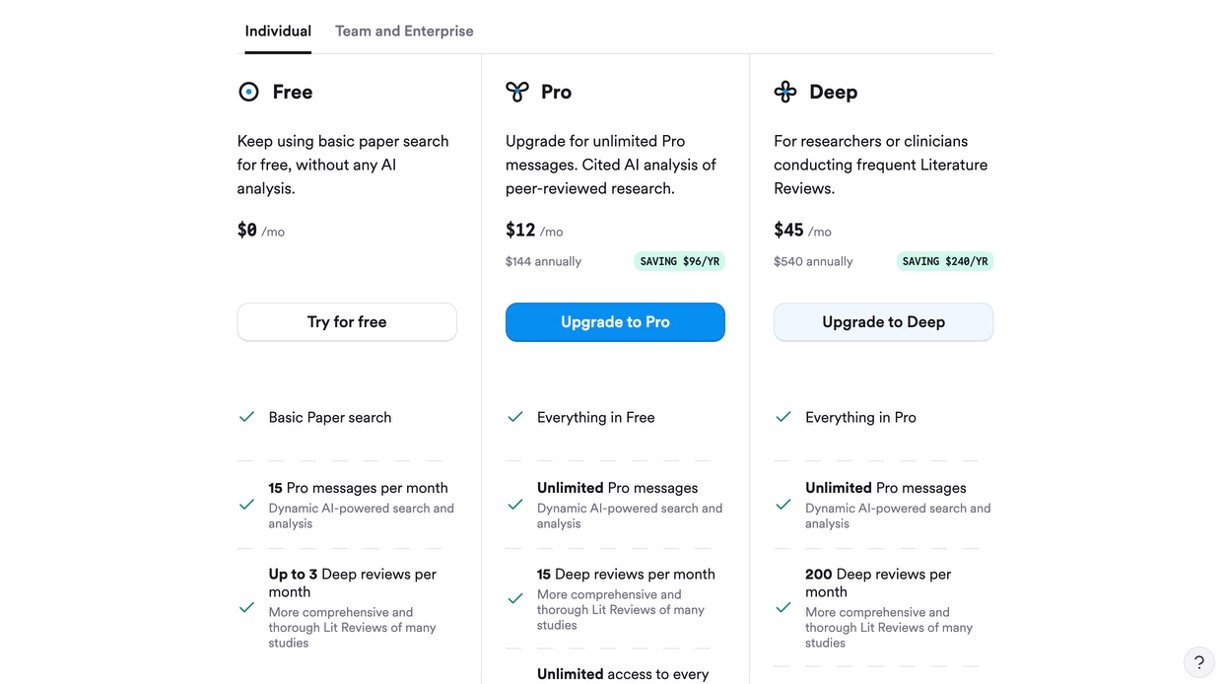
Free: $0 with unlimited Paper Searches, limited Pro messages, three Deep Reviews, and 10 Study Snapshots per month.
Pro: $20 monthly or $144 yearly ($12 per month when billed annually). It includes unlimited Pro messages, 15 Deep Reviews per month, and unlimited Study Snapshots.
Deep: $65 monthly or $540 yearly ($45 per month billed annually), with 200 Deep Reviews per month. Team plans use custom pricing and include 50 Deep Reviews per user.
Final Verdict
Consensus is one of the better AI tools for evidence-based research. It suits students, writers, clinicians, and researchers who need faster paper discovery and clear summaries. Use it to find and organize evidence, then verify important claims in the original studies.

